Quick links
Indian Register
DCHP-2 (Nov 2010)
Spelling variants:Indian register
n. & adj. — Law, Administration, Aboriginal
the record kept by the federal government of the names of all status Indians.
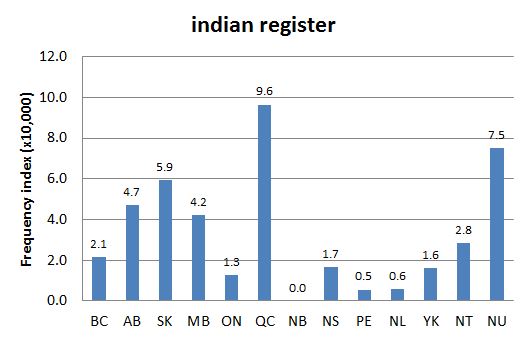
Type: 1. Origin — The Indian Register was created by the Canadian government in 1951 after changes to the Indian Act. It is based on records from as early as 1850 (see AANDC reference) and identifies all status or registered Indians in Canada, becoming the official record of Aboriginal people who qualify for certain rights and benefits. As Chart 1 shows, the term is most frequent in Canada; Chart 2 illustrates the terms use across all provinces (the exception of New Brunswick is an artefact of the data).
More importantly, the list comprises those members of First Nations towards whom the government accepts a level of responsibility (see status). Inclusions and exclusions to the list are disputed (see, e.g. Bill C-31). The Indian Registrar, an employee of what is now called the Department of Indigenous and Northern Affairs, is in charge of executing the current legislation on additions, changes and exclusions from the Indian Register.
More importantly, the list comprises those members of First Nations towards whom the government accepts a level of responsibility (see status). Inclusions and exclusions to the list are disputed (see, e.g. Bill C-31). The Indian Registrar, an employee of what is now called the Department of Indigenous and Northern Affairs, is in charge of executing the current legislation on additions, changes and exclusions from the Indian Register.
See: Band List,General List,Indian pay-list,registered Indian,treaty(meaning 3),treaty annuity,treaty list,treaty money,treaty roll,First Nation,status,treaty band,Bill C-31
Note that the term, while created in 1951, first appears in 1971 in two of Canada's largest newspapers, The Globe and Mail and the Toronto Star.
Quotations
1964
The first [definition], which refers to what are usually called "registered Indians," is the legal definition used by the Indian Affairs Branch for the people who come under the jurisdiction of the Indian Act; that is, those whose names are included on the official Indian Register, either on a Band List or a General List.
1971
Harold Chapman, registrar with the department, said in a telephone interview from Ottawa that a directive from the department has been sent to its agents to discontinue removing such Indian women from the Indian register.
1971
The Federal Court of Appeal decision overturned a lower court ruling which stripped Mrs. Lavell, an Ojibway, of her Indian status after she married a non-Indian student at Ryerson Polytechnical Institute in Toronto. A Department of Indian Affairs directive issued last week halted the removal of women's names from the Indian register if they married non-Indians.
1973
Mrs. Jeanette Lavell married a non-Indian. She was promptly struck from the Indian register. All perfectly legal and proper. Mrs. Lavell decided, however, regardless of what the Registrar General of the Department of Indian Affairs stated, she was still an Indian. She appealed the decision of the Registrar to the Courts. The first decision felt that there was no conflict between the Bill of Rights and the Indian Act. Mrs. Lavell appealed again. This time she was lucky.
1987
As of May this year, more than 90,000 people had asked to be reinstated on the Indian Register, which would make them eligible for education and social services benefits.
1989
The accords provided those listed on the Indian register with an annual $5 annuity payment and other modest benefits, such as a few boxes of rifle shells, twine fishing nets every year, and a new set of clothes for the chief and four band councillors every third year.
2011
The Indian Register is the official record identifying all Registered Indians in Canada. Registered Indians are people who are registered with the federal government as Indians, according to the terms of the Indian Act.
References
- AANDC • "The Indian Register"
Images
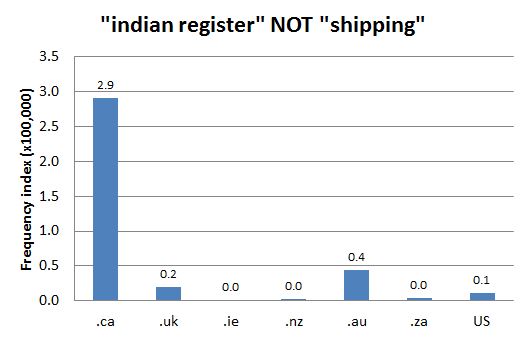
Chart 1: Internet Domain Search, 9 Jun. 2016